NOTE: This article was published in the Spring 2024 edition of the Clearwater Defender, and is now somewhat dated. If you are interested in receiving articles like these to your home or inbox, consider becoming a member here.

In last summer’s Defender (summer 2023) we reported on the results of a lawsuit resulting in a federal court judge ordering the U.S. Fish & Wildlife Service (USFWS) to update an Environmental Impact Statement (EIS) from 2000 outlining federal government actions to recover grizzly bears in the Bitterroot Ecosystem (BE). Since the court’s decision, the USFWS submitted a timeline for updating the EIS that included an initial 60-day scoping (public comment) period, which ended March 18, 2024.
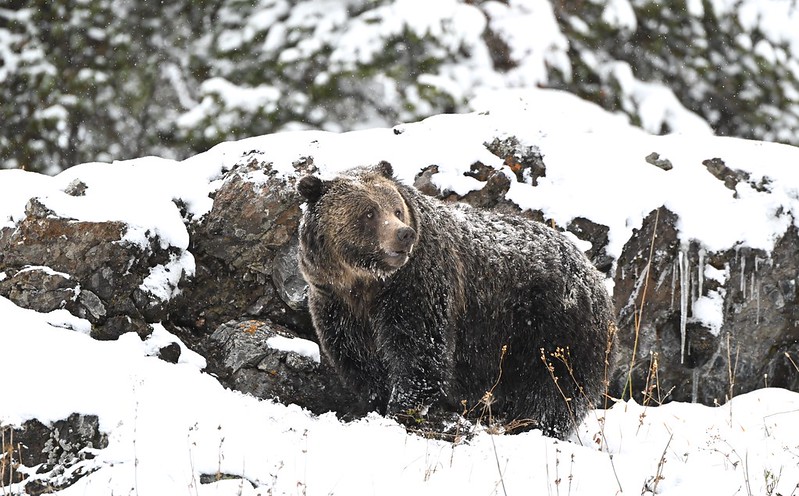
The EIS will consider options for restoring grizzly bears to the BE, a geographic area mostly in Idaho with a very sparse grizzly population, but has nevertheless been identified as important for recovering this threatened species across its former range.
During the scoping period, a coalition of organizations including FOC submitted a letter describing the Citizen Alternative: Natural Recovery with ESA Protection and Connectivity Areas. “Natural Recovery” under this Citizen Alternative means taking actions to facilitate natural immigration from other areas with denser grizzly populations.

Under our Natural Recovery alternative, the BE—the primary geographic recovery unit—would be expanded to 21,612 square miles, encompassing the Selway-Bitterroot, Frank Church-River of No Return and Gospel Hump Wildernesses and surrounding primarily federal public lands on the Nez Perce- Clearwater and six adjoining National Forests. This boundary delineation is informed by the results of numerous peer-reviewed and published analyses of grizzly bear habitat potential.
"Already the USFWS too often authorizes lethal and other heavy handed control actions as grizzly bears [a federally-protected species] come into conflicts."
Our Natural Recovery alternative also establishes a larger BE Demographic Monitoring Area, which includes a buffer zone 10 miles wide surrounding the Recovery Area plus Connectivity Areas linking the BE to three others: the Cabinet-Yaak, Northern Continental Divide and Greater Yellowstone. This would direct the USFWS to prepare a Conservation Strategy with DMA management recommendations for the
Forest Service, Bureau of Land Management (BLM) and the states of Idaho and Montana. The Conservation Strategy would set standards to be amended into land management plans for the national forest and BLM lands within the DMA.
Standards and other measures in our Natural Recovery alternative are intended to increase habitat security for bears. These include:
The Natural Recovery alternative also calls for:
Based on the USFWS’s original solicitation for comments (found at https://www. fws.gov/BitterrootEIS along with more information), the agency may be favoring an alternative featuring artificial population augmentation. This means trapping and relocating grizzly bears from other recovery zones into the BE to establish an “experimental, nonessential population” of grizzly bears under the 10(j) rule of the Endangered Species Act (ESA). FOC opposes this idea for three major reasons. For one, under 10(j) grizzlies in the BE would not enjoy full protections as a Threatened species under the ESA. Already the USFWS too often authorizes lethal and other heavy-handed control actions as grizzly bears come into conflicts, so the agency would be even less likely to favor nonlethal actions for individual bears. Second, research has shown that people in Idaho would be far more accepting of grizzly bears naturally repopulating than “government bears” brought in artificially. Finally, the USFWS is likely to keep its unscientific 2000 recovery area boundary, which is too small to support a viable population and assist with grizzly bear recovery across the Northern Rockies.
From USFWS’s timeline, the next (and perhaps only remaining) formal public input opportunity will be in July 2025 when the draft EIS is issued for a 60-day comment period. After that, the agency anticipates issuing a final Record of Decision in October 2026. If the decision is to declare and/or establish an “experimental, nonessential” population, the USFWS would institute a subsequent rulemaking under section 10(j) of the ESA soon after.
The USFWS needs to hear support for our Natural Recovery alternative and strong opposition to any experimental, nonessential 10(j) rule. Please go to our website under www.friendsoftheclearwater.org/grizzly-bear- recovery/ to find our comment letters describing the Natural Recovery alternative, an alert with talking points, and a link for sending an email to USFWS director Martha Williams.
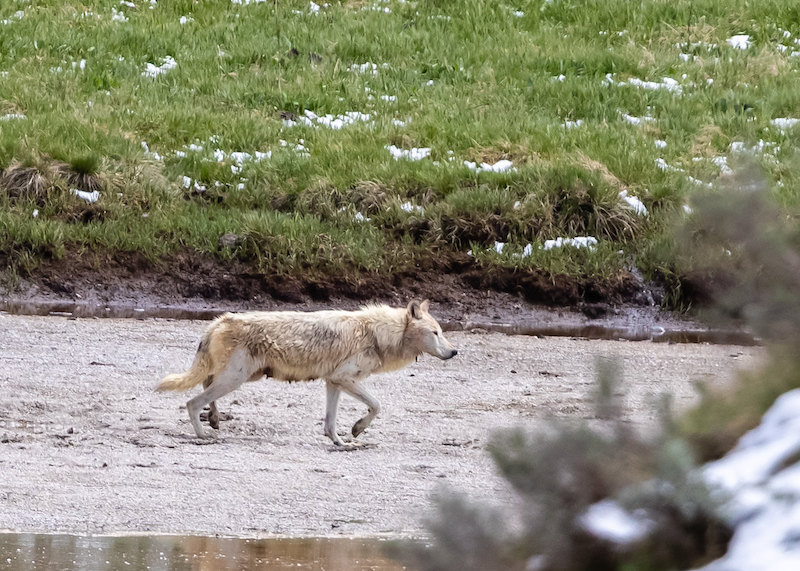
On April 8, wildlife advocacy and conservation groups including Friends of the Clearwater filed a lawsuit in the U.S. District Court of Montana, intending to gain protections under the Endangered Species Act (ESA) for the gray wolf in the states of Idaho, Montana and Wyoming. This action comes on the heels of the Feb. 7 determination by the U.S. Fish and Wildlife Service (USFWS) that the Western U.S. distinct population segment (“DPS”) does not warrant listing as an endangered or threatened species under the ESA. FOC is joined by Nimiipuu Protecting the Environment, Western Watersheds Project, Wilderness Watch, Protect the Wolves, WildEarth Guardians, Trap Free Montana, International Wildlife Coexistence Network, Alliance for the Wild Rockies and Predator Defense in this litigation, with Kelly Nokes at Western Environmental Law Center as lead attorney.

The status of the gray wolf under the ESA is long and complicated. Adoption of a 1978 rule made it one of the first species listed as Endangered. Decades later, after both artificial reintroduction and natural recovery in the western U.S. had expanded the wolf population, political pressure built towards delisting. Litigation halted USFWS delisting of the Western DPS in 2008, and again in 2009 for a Northern Rocky Mountains (“NRM”) subpopulation including Montana and Idaho. But in 2011, in what was widely seen
as an election year move, Senator Jon Tester (MT) attached a legislative rider that delisted wolves in Montana and Idaho. Litigation prevented delisting of wolves in Wyoming in 2012, but by 2017 it was court- approved.
Then in 2021, FOC as part of a coalition of dozens of groups petitioned the USFWS to re-list the gray wolf Western U.S. DPS, citing “new laws in Idaho and Montana, and longstanding wolf management in Wyoming ...intended to reduce gray wolf populations in the core wolf recovery zone by 85 to 90 percent by incentivizing wolf killing and authorizing use of new methods to kill wolves.” That spurred a USFWS Status Review which preceded their “not warranted” determination, leading to our latest legal efforts.

Regardless of the abject cruelty demonstrated by states’ promotion of aggressive killing regimes that feature aerial gunning, killing pups for bounties, widespread traps and snares, night hunting, shooting over bait, and even running them over with snowmobiles, the decimation of wolf populations makes no sense ecologically. The many ecosystem types wolves inhabit are unique communities of plant and animal life enhanced by the healthy wolf populations and predator- prey relationships. Wolves have been described as a keystone species, and scientists have noted its return has triggered cascading ecological shifts toward increased bird and mammalian diversity, dampened population fluctuations of prey species, and changed patterns of vegetation.
Those of us having the opportunity to directly observe wolves in our incredible shared landscapes see them as our wild relatives in this community of life. Because the USFWS is failing in its oversight and conservation duties, we are asking the court to step in and reject the primitive, fear-based impulses exhibited by state wildlife agencies.
Friends of the Clearwater
PO Box 9241
Moscow, ID 83843
(208) 882-9755