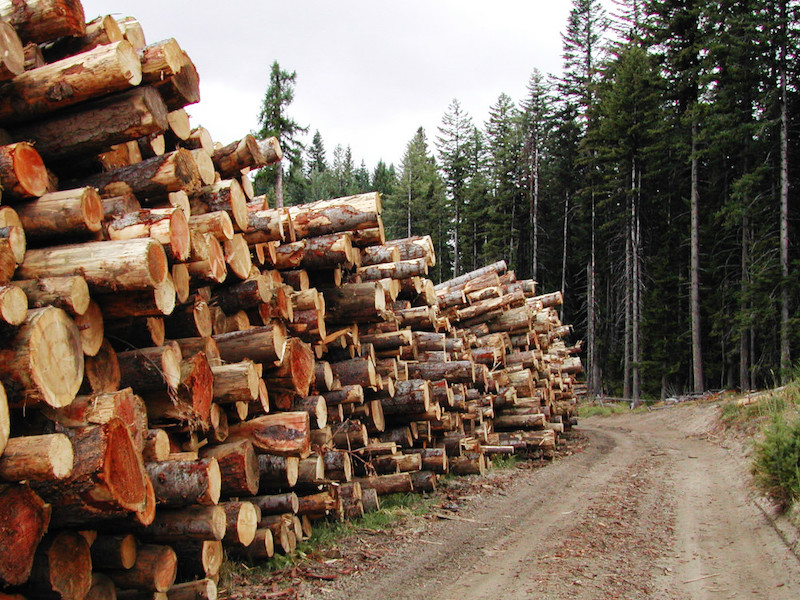
One purpose of the National Forest Management Act (NFMA), passed by Congress in 1976, was to address the growing controversial practice of clearcutting on U.S. national forests. Clearcut logging involves removing all or most trees over a given stand, to be sold as timber. The practice inflicts significant damage to the other resources found in natural forest ecosystems. NFMA limited the size of clearcuts on most national forests in the western U.S. to 40 acres, but the law also contained loopholes.
In recent years Friends of the Clearwater noticed a growing trend in national forests of the Northern Region exploiting NFMA’s clearcutting loopholes. Our staff investigated and prepared a report in 2021.
Our report revealed a drastic increase of requests from Forest Supervisors to the Regional Forester, who is authorized to approve such exceptions to the 40-acre limit. Total acres of these “supersized clearcuts” in the Northern Region averaged less than 10,000 acres annually from 2013-2018, but ballooned to exceed 32,000 acres in 2020. We found not a single instance of a request being denied by Regional Forester Leanne Marten.
Read the embedded report below, or scroll to the bottom of the page to download the PDF.
The-Clearcut-Kings_USFS-Northern-Region-and-Obsession-w-Supersized-Clearcuts-2021
During the Clinton administration, public outcry over logging wildlands on national forests was amplified by campaigns such as Cove-Mallard in the Nez Perce National Forest. These actions rallied citizens from around the country to conduct direct action in protest of massive roadbuilding and clearcutting of roadless areas. Such publicity resulted in the Clinton administration proposing a nationwide regulation to limit exploitation of these remaining unprotected wildlands. The resulting 2001 Roadless Area Conservation Rule was touted as a major victory by many conservation groups.
In 2020, Friends of the Clearwater completed an investigation into the effectiveness of the 2001 rule—and another crafted in 2008 to apply to national forest lands within the state of Idaho—to preserve wilderness character of roadless areas.
Virtually unknown to the general public, we found the exceptions written into these rules were being exploited by the U.S. Forest Service, authorizing the development of roughly 39,000 acres of wild roadless areas in Montana and 18,000 acres in Idaho. Mostly this happened because loopholes allow industrial activities promoted as “habitat restoration”—a justification of logging by the Forest Service that has become ubiquitous. Use of these loopholes has accelerated since 2010.

In 2022, the House of Representatives passed a package of bills that would have codified the 2001, Idaho, and Colorado Roadless Rules as law. Because of the complete lack of knowledge of the problems of these rules on the ground, many in the conservation community saw this as a step forward. Luckily, the omnibus bill did not pass the Senate, and the roadless rules (and the loopholes they contain) are not federal law.
To permanently protect roadless areas, Friends of the Clearwater supports legislation that would close the loopholes of the various roadless rules and set a higher standard for their protection. FOC also supports a bill that would protect roadless country in our region that has been introduced into Congress several times: The Northern Rockies Ecosystem Protection Act (NREPA). Among other important provisions, NREPA protects as Wilderness essentially all the roadless areas in the Nez Perce-Clearwater National Forests and most other roadless areas in the bioregion defined by that proposal. You can learn more here.
Read the entire report below, or download the PDF a the bottom of the page.
Bilodeau-Macfarline-THE-ROADLESS-REPORT-FINAL-with-addendum-update-Sept.-2020
In 2022, Friends of the Clearwater organized a first-of-its-kind analysis of the carbon impacts of the draft Nez Perce-Clearwater Revised Land and Resource Management Plan (AKA the "Forest Plan").
John Talberth, an economist with the Center for Sustainable Economy, completed the following report, which analyzes how current carbon stocks in the Nez Perce-Clearwater National Forests (NPCNF) would change under different management directives.
The findings show that under the NPCNF forest plan, carbon emissions would increase. Under the newly revised version of the forest plan, the emitted carbon from logging, burning, and roadbuilding would be like putting hundreds of thousands of cars on the road. The report emphasizes the importance of accurate carbon accounting in forest management and the consequences of increased logging poses to our atmosphere and climate.
The report reveals the amount of greenhouse gas (GHG) emissions from implementing the revised forest plan, something the US Forest Service has so far refused to do. Such inaction is morally reprehensible during such a critical moment for our shared climate.
Funding for the report was generously provided by the Charlotte Martin Foundation.
CARBON LIFECYCLE ANALYSIS
Talberth's findings rely on knowing how carbon, a chemical building block of trees, actually transforms over the life of trees and forests, both logged and unlogged.
In a wild (unlogged) forest ecosystem, carbon stocks are high and relatively stable. As trees die and decay, they release carbon dioxide, and as saplings grow, they absorb it. Large disturbances like wildfire will reduce carbon stocks, but even large fires release 3-5% of forest carbon, mostly by burning needles, leaves, and the top layer of the forest floor.
Logging dramatically alters the carbon cycle in forests. Each stage of the logging process reduces forest carbon stocks by emitting carbon dioxide. Short-lived forest products (like paper) are quickly used, discarded, and decompose, emitting most of their carbon. Even long-lived forest products like dimensional lumber only store a fraction of the carbon of the original tree. Over the course of logging—felling, limbing, slash burning, and milling—roughly 85% of the carbon of a tree is lost, on average.

CLIMATE IMPACTS OF THE FOREST PLAN
The impacts of climate change, exacerbated by accelerated timber production, put Idaho's public lands at serious risk. According to the report, increased carbon pollution, and the global heat and climate dysfunction it brings, are already disrupting natural processes, making the land:
"more susceptible to heat waves, droughts, water shortages, wildfires, wind damage, landslides, floods, warming waters, harmful algae blooms, insects, disease, exotic species, and biodiversity loss."
At such a critical moment, utilizing the natural capacity of protected forests as carbon sinks should be the priority of our public land managers, not exacerbating climate dysfunction.
You can read the entire report below, or download the PDF at the bottom of the page.
Talberth_2023
Written by Friends of the Clearwater Forest Policy Director Jeff Juel, this report examines 40 years of U.S. Forest Service policies on management of old-growth forests. The document is a clear-eyed view of the agency's long-term prioritizing of older forests for timber production above all other values.
The report extensively cites dozens of scientific research articles and viewpoints, comparing and contrasting them with numerous Forest Service policy documents and statements. The report promotes the values of old growth the agency has too easily dismissed—its contribution to a stable climate, its diversity lending habitat for rare species, its role in producing clean air and water, and its effects on human aesthetic appreciation and imagination.
The concept of old growth generally refers to areas of forest where many trees approach their upper threshold of age and size, where tree age, canopy structure and composition is complex, where soils are well-developed, and where dead and decaying trees create structural diversity. These habitats have developed very high levels of biological diversity.
Old growth also provides unique ecosystem services. Forests naturally store (sequester) carbon dioxide. Old forests also exert huge impacts on the water cycle, whether by supplying clean spring water, increasing forest humidity, or mediating the impacts of heavy rain and snow on waterways.
Without human management, upwards of 25 to 30% of a forest landscape may be within an accepted definition of "old growth" at any given time. Old growth is better understood as a specific kind of forest landscape that is approaching its zenith of complexity, rather than an individual tree that is old and large. In turn, natural changes in fire regime, climate, vulcanism and other disturbances over the millennia alter the natural processes influencing forest functions and structure.
The presence of large trees has made old forests prime targets for industrial timber production, which has obliterated most old growth from U.S. forests. Contrary to popular belief, old growth on publicly-owned national forests are not, in general, protected from logging.
The report also examines the pseudo-scientific justifications to greenwash industrial logging. These include claims that logging reduces fire risk and severity, reduces insect infestations, and promotes growth of larger trees, among others.
In order to serve timber interests the Forest Service must foster the view that old growth is something needing management, not a value needing protection. Industrial timber production and intrusive management is not compatible with the conservation of old growth forests, and until federal agencies make policies to reflect that, the future for this already rare habitat is dire.
Read the embedded report below, or download the PDF at the bottom of this page.
Juel_2021-Old-GrowthFriends of the Clearwater
PO Box 9241
Moscow, ID 83843
(208) 882-9755