The Canada lynx (Lynx canadensis) is a rare wildcat native to the boreal forests and mountains of North America. Lynx rely on ample populations of snowshoe hare, their main prey, to survive.
Conservation status: Threatened
The Canada lynx (Lynx canadensis) is a medium-sized wildcat with large feet, notable for its dependence on the snowshoe hare, its main prey. It is a secretive and wide-ranging species, relying on vast, interconnected wildlands to survive.
Although they are roughly the same size as their nearest relative, the bobcat, lynxes have larger feet, thicker fur, and a duller appearance. These adaptations allow lynxes to travel across the deep snowpack of the high Rockies, silently stalking snowshoe hares, red squirrels, ruffed grouse, and other prey.
Canada Lynx were listed as a Threatened species under the Endangered Species Act (ESA) in 2000. In 2006 the U.S. Fish and Wildlife Service first designated Critical Habitat, then revised it in 2009 and 2014. The Service finalized the Recovery Plan in late 2024.
Physical Characteristics: 18 – 23 inches tall at shoulder, 31 – 40 inches long including tail, 15 – 40 pounds. Medium-sized, short-tailed, long-legged cat has huge feet and protruding ears tipped with 2 – inch black hairs. Fur is long, ranging in color from reddish, yellow-brown, to silvery-gray with dark spots or streaks and whitish underside. Large, furry feet allow to stalk prey in silence and travel fast in snow.
Diet: Specialist predator. Snowshoe hare typically makes up bulk of diet – in the populations further north, when hare populations crash so do lynx populations. Secondary prey includes squirrels, other rodents, and grouse. Primarily solitary hunter of remote forests, largely nocturnal with more diurnal activity in winter, and will cache uneaten kill under snow or leafy debris.
Habitat: Depends on dense conifer forests for security and denning. Numerous fallen trees, rocky outcrops, and occasional dense thickets serve as effective cover; these ambush sites are desired habitat components. Forest edges, which provide food for lynxes’ major prey – snowshoe hare – are critical.
Range: Primarily inhabit boreal forests and occur across much of Canada and Alaska, and into northern US border states including Minnesota, Maine, Washington, Idaho, and Montana and extending southward in the Rocky Mountains though portions of Utah, Wyoming, and Colorado. Individual home ranges vary and documented between 3 – 300 square miles. In Lower 48, populations and densities tend to remain low. Historically found throughout Clearwater Basin. Confirmed sighting by Forest Service wildlife biologist occurred along Lochsa River in early 2000s.
Reproduction: Breeding season lasts one month, ranging from March – May depending on local climate. Females attract males by leaving urine where males mark their territory, and by repeated calling. Female will only mate with one male each season, though a male may mate with multiple females. Females produce one to five kittens in May – June; kittens stay with mother through first winter and share den site until mature enough to leave.
Threats: Trapping reduced numbers historically, accidental catch while trapping legal furbearers likely continues; current threats also include habitat destruction/fragmentation from human development, logging, road building, motor vehicle traffic, and snowmobiles.
Miscellaneous: Desired for their fur, population records kept by Canadian government and Hudson’s Bay Company date back to 1730s. Predator-prey relationship between lynx and snowshoe hare well documented for decades; each respective population parallels the other – when hare numbers decline, the change in lynx diet causes productivity of adult females and survival of young to nearly cease.
Other animals benefit from lynx superior stalking skills; the Great Horned Owl will station itself above the lynx and wait for it to flush prey out of hiding place, and then swoop down and capture its meal before the lynx can get it.
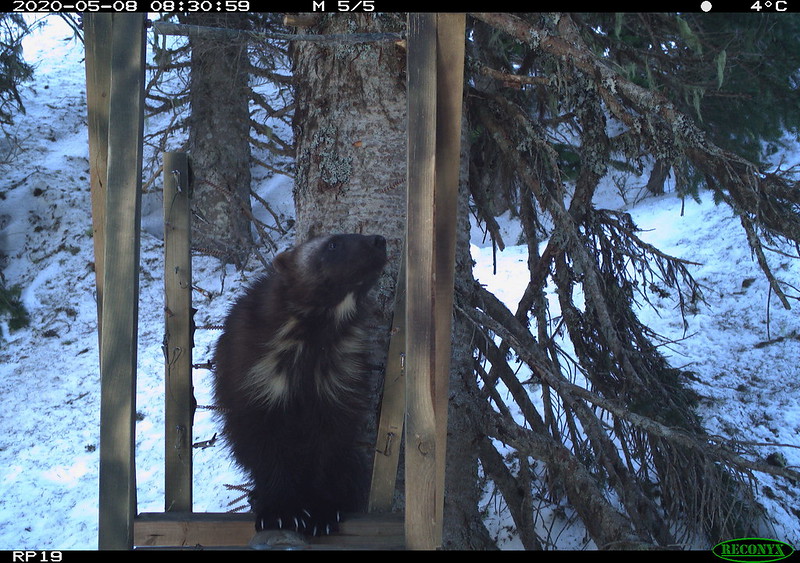
The wolverine is the largest terrestrial member of the weasel family in North America. They are very rare but wide-ranging carnivores, traveling across mountains and forests in search of food.
Conservation status: Threatened
Few have ever set eyes on a wolverine (Gulo gulo) in the wild. A secretive wanderer of mountain ridges and forests, wolverines are perhaps the greatest symbol of the wilderness of the Rocky Mountains. Although they weigh less than most household dogs, this carnivore has a reputation for ferocity—researchers have recorded them hunting moose.
Wolverines are extremely rare. Some biologists believe there are only 300 in the contiguous US in total. This is, in part, because of their unique role in the ecosystem. Wolverines have big, flat feet to walk on top of deep snowpack, thick fur coats, and keen noses. Their reliance on snowpack for hunting and denning makes them extremely sensitive to climate change.
In late 2023, after decades of pressure from activists, the US Fish and Wildlife Service listed the population of wolverines in the contiguous US as threatened under the Endangered Species Act.
Physical Characteristics: 12 – 18 inches tall at shoulder, 24 – 48 inches long, and 15 – 35 lbs. Large, muscular, agile weasel with small head, bushy tail, short legs, and large paws with cinnamon-brown – nearly black fur. Pale tan stripe runs down each side from shoulder to tail. Possesses one of most powerful jaws of any mammal on planet. Has a reputation for ferocity that far out matches its size.
Diet: Incredibly powerful for size; have ability to take down deer, caribou, mountain goats, and occasionally moose, particularly if weakened in harsh winter or deep snow. Generally prey on mice, ground squirrels, birds, beavers, and other rodents. Adept scavengers particularly during winter months.
Habitat: Large territory encompassing great variety of habitats. During winter inhabit lower elevations/valleys in pursuit of prey. In summer occupy ridges/mountains (pursuit of prey), including sub-alpine/alpine landscapes. Regardless of season, require large/remote protected areas in order to survive, with little/no human disturbance.
Range: Very small populations in Canadian/Northern Rockies; roams coniferous forests of Montana, Wyoming and Idaho. Even smaller populations in Northern Cascades of Washington/Oregon, and Central Rockies of Colorado. Sightings in Wallowa Mountains of northeastern Oregon. Best available science indicates less than 300 in Lower 48; Clearwater Basin one of last great strongholds.
Reproduction: Breeds from April – September but embryos do not implant until early winter if mother has adequate fat stores. Litter of 1 – 5 kits born between late-February and mid-April. Born blind and deaf; kits nurse for 8 – 9 weeks before leaving den with mother to acquire hunting skills. Kits typically spends first winter with mother, before sexually maturing and dispersing following spring.
Threats: Trapping, road building, logging, and recreation (motorized and non-motorized) have negatively impacted past two centuries. Climate change is serious concern; species depends on snow pack for habitat, denning, scavenging, and raising young.
Miscellaneous: Known as “skunk bear” because produces smell that rivals skunk. Abundant stinky scent produced in anal glands and used to mark territory. Wolverines and skunks are part of Mustelidae family. Wolverines also referred as “Symbol of Wilderness”.
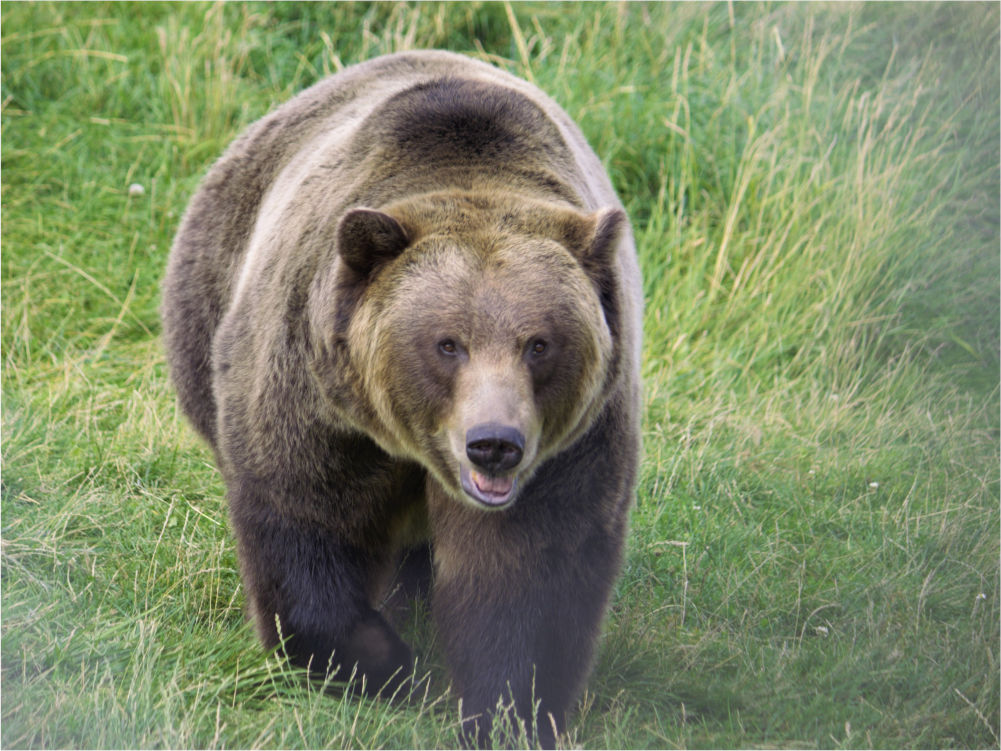
The largest carnivores of the Wild Clearwater, grizzly bears (also called the North American brown bear) were listed as a threatened species under the Endangered Species Act (ESA) in 1975.
Conservation status: Threatened
There are few animals more wondrous than the grizzly bear (Ursus arctos horribilis). Both physically large and intelligent, it is no surprise many call this omnivore the "Great Bear". Grizzly bears are ingrained into the fabric of the American West, in Indigenous stories, folk tales, and even the Californian flag.
Beginning in the 1800s, tens of thousands of grizzly bears (some 98% of the population in the lower 48 States) were shot, trapped, or poisoned to near extinction. In 1946, US Forest Service ranger Bud Moore saw one of the last signs of grizzly bears in the Clearwater—one dry footprint.
In 1975, grizzly bears were listed as a threatened species, surviving only in Glacier and Yellowstone National Parks, the Idaho Panhandle, and perhaps other remote areas.
In the 50 years since, populations have grown slowly and grizzly bears have expanded their ranges. Unfortunately, efforts to remove federal protections are frequent, developments in the wildland-urban-interface are accelerating, and grizzly mortality remains extremely high, almost entirely due to human pressures.
Central Idaho has the best unoccupied grizzly bear habitat in the lower 48 states, what one Montana researcher calls the "grizzly bear promised land". Since 2007, when a grizzly was illegally killed near Kelly Creek, several presumably male grizzly bears have been documented in Clearwater Country, but as of 2025 no known breeding population exists in north-central Idaho.
As of 2025, grizzly bears remain threatened and the US Fish and Wildlife Service is analyzing how to recover grizzly bears in the Bitterroot Ecosystem.
Description: Equipped with massive shoulders and muscular necks, females weigh between 300 – 450 lbs., with males averaging 400 – 800 lbs. Largest males can weigh over 1,000 lbs. Shoulder height is approximately 36 inches; body length is 72 – 96 inches. Run up to 35 mph and have long, non-retractable claws for digging. Brown – yellow – cinnamon fur with distinguishable back or shoulder hump (black bears do not have hump).
Diet: Largely omnivores, 70 – 80% of diet is vegetation, including roots, stems, leaves, flowers, nuts and berries. Adept at digging up insects, squirrel caches, marmot dens and mice. Also prey on larger mammals, particularly young elk, deer and moose. White-bark pine nuts historically invaluable source of nutrition; has severely declined in the Clearwater for several decades due to fungal disease and is declining in drier parts of the Rockies due to climate change. Other traditional food losses (salmon, steelhead trout, huckleberries) are also in decline.
Habitat: Once prominent along short-grass prairie of West; now largely limited to ridges, mountains, and forested landscapes of Northern Rockies. Require large tracts of protected landscapes with minimal road density and human disturbance. Denning usually begins October/November and hibernates throughout winter. During hibernation, grizzlies do not eat or drink, and very rarely urinate or defecate.
Range: Five designated recovery zones: Greater-Yellowstone, Northern Continental Divide, Cabinet-Yaak, Selkirk, and Bitterroot; latter includes portions of the Clearwater Basin. These recovery zones are geographically isolated—a major hurdle for true recovery. Long-term survival of grizzly bears in the United States requires connected habitat, for example between Yellowstone and the Bitterroot Ecosystem through the Centennial range. These corridors need to be included in designated recovery areas.
Reproduction: Produce cubs every other year or every three years; do not breed until 5-7 years of age. Typically mate June/July, but embryos do not implant until October/November if sow has adequate fat stores. Sows give birth (typically one or two, rarely as many as four) cubs in January. Cubs emerge from den in April/May with mother.
Threats: Road building, logging, habitat loss/fragmentation, poaching, and loss of high quality foods. Lack of connectivity (bears moving/breeding with bears in other recovery zones) is also a major threat.
Legal Status: Remain listed as threatened under Endangered Species Act despite wrongful attempts of federal government to remove from Endangered Species List.
Local Sightings: In 2007, a 500 – 600lb. male grizzly bear shot/killed in Kelly Creek drainage on Clearwater National Forest by client of local outfitter. DNA results indicate bear dispersed from Selkirk Mountains in North Idaho, the first confirmed grizzly bear in North Central Idaho in approximately sixty years.
In 2018, male grizzly appeared in Bitterroot Valley of Montana but was relocated north of I-90.
In 2019, at least two grizzly bears were confirmed in central Idaho, including near White Bird and Newsome Creek on the Nez Perce National Forest and near Lolo Pass on the Clearwater National Forest.
In April of 2020, grizzly tracks were confirmed just south of Grangeville, the first evidence of year-round grizzly presence in the Clearwater in decades.
In 2022, two grizzlies frequented the Bitterroot valley between Lolo and Florence, just east of the Selway-Bitterroot Wilderness. The Montana Dept. of Fish, Wildlife, and Parks captured the bears and released them in the Sapphire Mountains. The bears had "not yet been in conflict with people".
In 2024, a young male grizzly was shot at a black bear bait station near St. Maries, Idaho in the St. Joe watershed. According to news reports, the hunter had sent in video footage to the Idaho Department of Fish and Game to help identify the bear, since he was not sure if it was a cinnamon-colored black bear or a young grizzly. After shooting the bear, and discovering it was actually a grizzly, the hunter reported the incident to Idaho Fish and Game. Shockingly, an employee said via email "we don’t need griz in the Joe." This is further evidence that state-management of grizzly bears would be a serious loss to protection of the species.
In 2025, the IDFG updated black bear hunting rules to require completing an identification quiz online to distinguish grizzly and black bears.
NOTE: This article was published in the Spring 2024 edition of the Clearwater Defender, and is now somewhat dated. If you are interested in receiving articles like these to your home or inbox, consider becoming a member here.
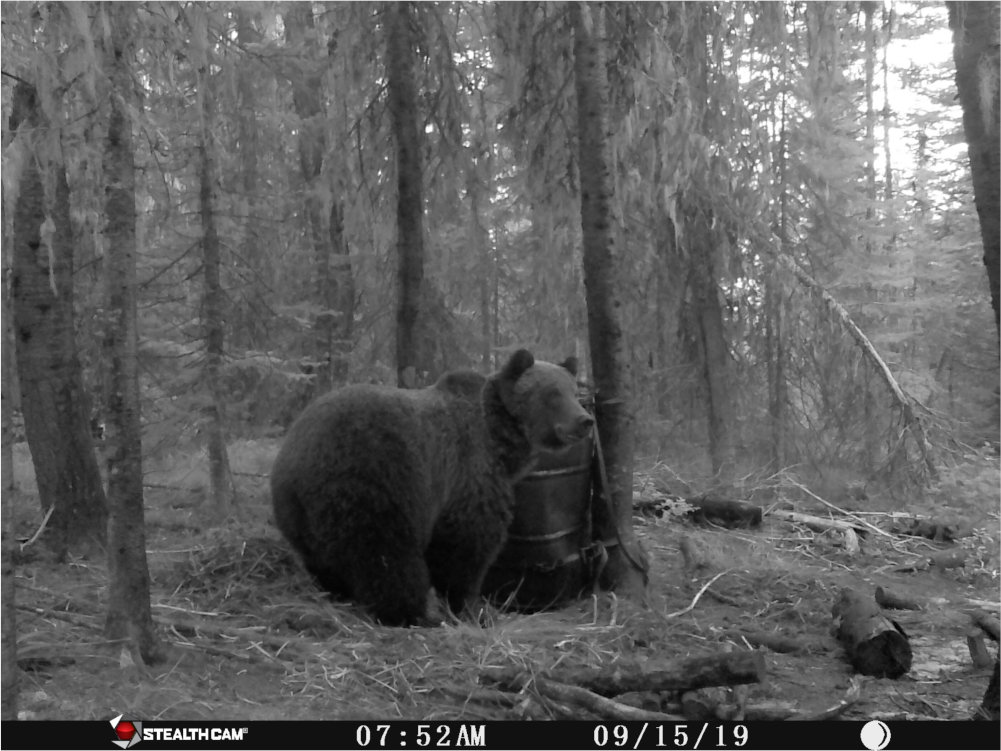
In last summer’s Defender (summer 2023) we reported on the results of a lawsuit resulting in a federal court judge ordering the U.S. Fish & Wildlife Service (USFWS) to update an Environmental Impact Statement (EIS) from 2000 outlining federal government actions to recover grizzly bears in the Bitterroot Ecosystem (BE). Since the court’s decision, the USFWS submitted a timeline for updating the EIS that included an initial 60-day scoping (public comment) period, which ended March 18, 2024.
The EIS will consider options for restoring grizzly bears to the BE, a geographic area mostly in Idaho with a very sparse grizzly population, but has nevertheless been identified as important for recovering this threatened species across its former range.
During the scoping period, a coalition of organizations including FOC submitted a letter describing the Citizen Alternative: Natural Recovery with ESA Protection and Connectivity Areas. “Natural Recovery” under this Citizen Alternative means taking actions to facilitate natural immigration from other areas with denser grizzly populations.
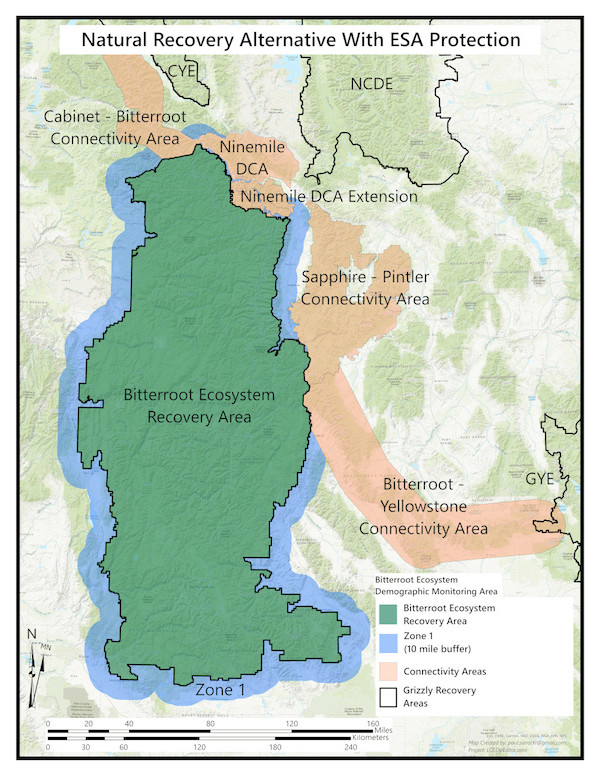
Under our Natural Recovery alternative, the BE—the primary geographic recovery unit—would be expanded to 21,612 square miles, encompassing the Selway-Bitterroot, Frank Church-River of No Return and Gospel Hump Wildernesses and surrounding primarily federal public lands on the Nez Perce- Clearwater and six adjoining National Forests. This boundary delineation is informed by the results of numerous peer-reviewed and published analyses of grizzly bear habitat potential.
"Already the USFWS too often authorizes lethal and other heavy handed control actions as grizzly bears [a federally-protected species] come into conflicts."
Our Natural Recovery alternative also establishes a larger BE Demographic Monitoring Area, which includes a buffer zone 10 miles wide surrounding the Recovery Area plus Connectivity Areas linking the BE to three others: the Cabinet-Yaak, Northern Continental Divide and Greater Yellowstone. This would direct the USFWS to prepare a Conservation Strategy with DMA management recommendations for the
Forest Service, Bureau of Land Management (BLM) and the states of Idaho and Montana. The Conservation Strategy would set standards to be amended into land management plans for the national forest and BLM lands within the DMA.
Standards and other measures in our Natural Recovery alternative are intended to increase habitat security for bears. These include:
The Natural Recovery alternative also calls for:
Based on the USFWS’s original solicitation for comments (found at https://www. fws.gov/BitterrootEIS along with more information), the agency may be favoring an alternative featuring artificial population augmentation. This means trapping and relocating grizzly bears from other recovery zones into the BE to establish an “experimental, nonessential population” of grizzly bears under the 10(j) rule of the Endangered Species Act (ESA). FOC opposes this idea for three major reasons. For one, under 10(j) grizzlies in the BE would not enjoy full protections as a Threatened species under the ESA. Already the USFWS too often authorizes lethal and other heavy-handed control actions as grizzly bears come into conflicts, so the agency would be even less likely to favor nonlethal actions for individual bears. Second, research has shown that people in Idaho would be far more accepting of grizzly bears naturally repopulating than “government bears” brought in artificially. Finally, the USFWS is likely to keep its unscientific 2000 recovery area boundary, which is too small to support a viable population and assist with grizzly bear recovery across the Northern Rockies.
From USFWS’s timeline, the next (and perhaps only remaining) formal public input opportunity will be in July 2025 when the draft EIS is issued for a 60-day comment period. After that, the agency anticipates issuing a final Record of Decision in October 2026. If the decision is to declare and/or establish an “experimental, nonessential” population, the USFWS would institute a subsequent rulemaking under section 10(j) of the ESA soon after.
The USFWS needs to hear support for our Natural Recovery alternative and strong opposition to any experimental, nonessential 10(j) rule. Please go to our website under www.friendsoftheclearwater.org/grizzly-bear- recovery/ to find our comment letters describing the Natural Recovery alternative, an alert with talking points, and a link for sending an email to USFWS director Martha Williams.
On April 8, wildlife advocacy and conservation groups including Friends of the Clearwater filed a lawsuit in the U.S. District Court of Montana, intending to gain protections under the Endangered Species Act (ESA) for the gray wolf in the states of Idaho, Montana and Wyoming. This action comes on the heels of the Feb. 7 determination by the U.S. Fish and Wildlife Service (USFWS) that the Western U.S. distinct population segment (“DPS”) does not warrant listing as an endangered or threatened species under the ESA. FOC is joined by Nimiipuu Protecting the Environment, Western Watersheds Project, Wilderness Watch, Protect the Wolves, WildEarth Guardians, Trap Free Montana, International Wildlife Coexistence Network, Alliance for the Wild Rockies and Predator Defense in this litigation, with Kelly Nokes at Western Environmental Law Center as lead attorney.
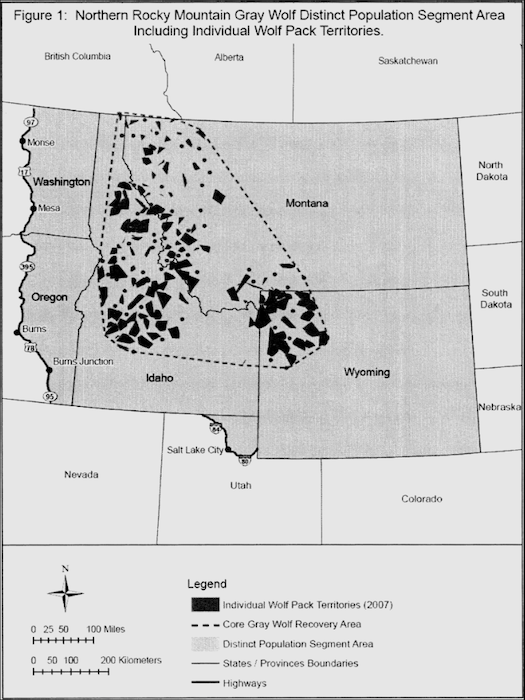
The status of the gray wolf under the ESA is long and complicated. Adoption of a 1978 rule made it one of the first species listed as Endangered. Decades later, after both artificial reintroduction and natural recovery in the western U.S. had expanded the wolf population, political pressure built towards delisting. Litigation halted USFWS delisting of the Western DPS in 2008, and again in 2009 for a Northern Rocky Mountains (“NRM”) subpopulation including Montana and Idaho. But in 2011, in what was widely seen
as an election year move, Senator Jon Tester (MT) attached a legislative rider that delisted wolves in Montana and Idaho. Litigation prevented delisting of wolves in Wyoming in 2012, but by 2017 it was court- approved.
Then in 2021, FOC as part of a coalition of dozens of groups petitioned the USFWS to re-list the gray wolf Western U.S. DPS, citing “new laws in Idaho and Montana, and longstanding wolf management in Wyoming ...intended to reduce gray wolf populations in the core wolf recovery zone by 85 to 90 percent by incentivizing wolf killing and authorizing use of new methods to kill wolves.” That spurred a USFWS Status Review which preceded their “not warranted” determination, leading to our latest legal efforts.
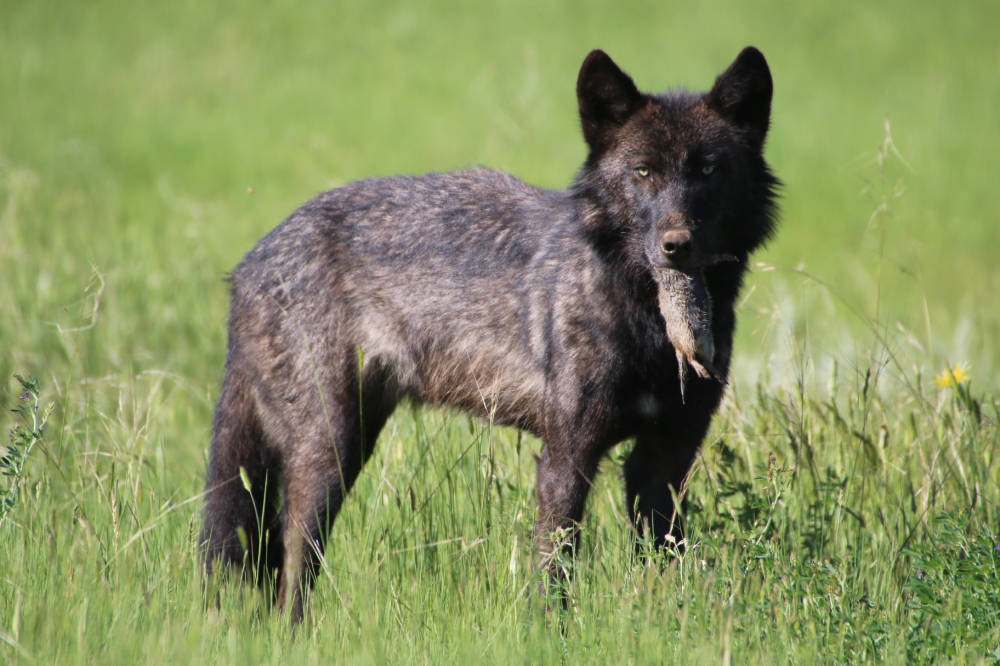
Regardless of the abject cruelty demonstrated by states’ promotion of aggressive killing regimes that feature aerial gunning, killing pups for bounties, widespread traps and snares, night hunting, shooting over bait, and even running them over with snowmobiles, the decimation of wolf populations makes no sense ecologically. The many ecosystem types wolves inhabit are unique communities of plant and animal life enhanced by the healthy wolf populations and predator- prey relationships. Wolves have been described as a keystone species, and scientists have noted its return has triggered cascading ecological shifts toward increased bird and mammalian diversity, dampened population fluctuations of prey species, and changed patterns of vegetation.
Those of us having the opportunity to directly observe wolves in our incredible shared landscapes see them as our wild relatives in this community of life. Because the USFWS is failing in its oversight and conservation duties, we are asking the court to step in and reject the primitive, fear-based impulses exhibited by state wildlife agencies.
Friends of the Clearwater
PO Box 9241
Moscow, ID 83843
(208) 882-9755