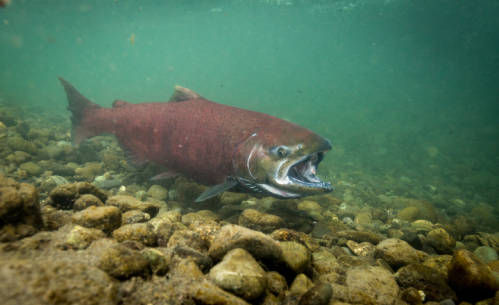
Chinook or king salmon are a threatened fish that live throughout the northern Pacific, from Japan to California. They are a keystone species in the Columbia Basin, where they bring ocean nutrients far inland as they migrate to spawn.
Conservation status: Threatened
Chinook salmon (Oncorhynchus tshawytscha), also called King salmon, are fish that spend most of their lives in the Pacific Ocean, only swimming upstream to breed, die, and begin the cycle of life anew. They are a keystone species of the Pacific Northwest that is preyed upon by animals as diverse as orca, salmon sharks, grizzly bears, cormorants, and osprey. Even in death, their nutrients benefit the region by increasing available nitrogen in soils, promoting tree growth.
The relationship between humans and Chinook salmon goes back a very long time. In Nimiipuu legend, it was the Chinook salmon who first offered itself as food to human beings, asking that in return human beings look after salmon.
Decline in Chinook and loss of cultural tradition in the Nez Perce Tribe go hand in hand. According to independent fish biologists, the Lower Snake River dams must be breached in order to save Chinook salmon in the Clearwater Basin.
Physical Characteristics: Largest species of Pacific salmon family, averages 33 – 36 inches long and 10 – 50 pounds; possible to grow to 5 feet long and over 100 pounds. Blue-green, red, or purple on back and top of head with silvery sides and white belly. Black spots occur on tail and upper half of body; mouth is often dark purple. During mating season they develop a reddish tint around dorsal fins and tail. Males have distinctively hooked mouth.
Diet: Juveniles feed on aquatic invertebrates, including crustaceans and amphipods. Adults ingest smaller fish.
Habitat: Needs fast-moving, freshwater streams and rivers. Oxygenation stimulates algae growth and other aquatic life which ultimately feed salmon. Needs clean, cool, sediment-free water to keep water temperatures low. Also needs intact riparian zone to protect smolts and juveniles. Adult salmon live 1-8 years in the ocean and adapt to varied environment.
Range: Found in cold, upper reaches of Pacific Ocean, from west coast of United States/western Canada and Alaska to Russian and Japanese waters. Clearwater Basin provides excellent spawning grounds in summer – often referred as summer Chinook. Fall Chinook run also occurs in lower Clearwater.
Reproduction: Maturity is reached at 3 – 7 years; at that point they journey upstream to natal waters – sometimes several hundred miles. Male/female may spawn at original birthing grounds. Female digs nesting hole (redd), and deposits thousands of eggs before male releases sperm. Male/female guard eggs during incubation, then adults die. First year or so (juveniles) stay in freshwater environment, moving gradually to estuaries, then open ocean.
Threats: Chinook salmon are listed as endangered, with abundant threats including overfishing, diversion and overuse of water resources, dams that alter the speed of water flow and block essential spawning routes, and habitat loss due to development. However, the spring/summer runs in the Clearwater are not listed because there is uncertainty as to whether these salmon are from natural migrants or from planted fish that came from Salmon River stocks.
Miscellaneous: Other commonly used names for this species are King salmon, Quinnat salmon, Spring salmon, and Tyee salmon. Native American tribes of the Pacific Northwest have teamed with state, federal, and academic groups to protect the species, improve habitat and facilitate natural processes. Chinook salmon were enthusiastically described and eaten in the journals of Lewis and Clark. The expedition first encountered the fish as a gift from Chief Cameahwait, brother of Sacajawea. At the first taste, the explorers were convinced they had crossed the Continental Divide.
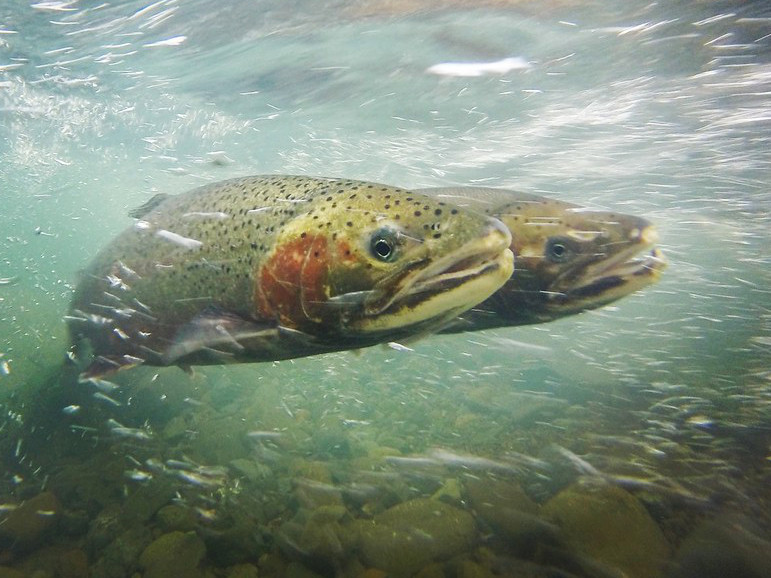
A migratory cold-water fish native to the West Coast of North America. Steelhead are a key part of Nimiipuu (Nez Perce) culture, as well as a popular sport fish.
Conservation status: Threatened
Steelhead trout, also called steelhead salmon, are genetically identical to rainbow trout. However, their lifecycle is anadromous, meaning they spend much of their lives in the ocean, traveling over 400 miles inland to breed in the cold headwaters of the Clearwater (rainbow trout, on the other hand, live their whole life in freshwater). Unlike salmon, most steelhead don't die after spawning, and can return to the ocean again.
Their numbers have declined dramatically since dams were built on the lower Snake River. Over 80,000 steelhead were counted at the Ice Harbor dam in the 1960s, dropping to about 15,000 by 1980 (an 80% decline).
Billions of dollars and decades of work have gone towards salmon and steelhead recovery in the region, with little effect. Breaching the lower Snake River dams (LSRDs) is necessary for recovering wild steelhead populations.
Eleven distinct populations of steelhead are protected under the Endangered Species Act. The Snake River Basin steelhead population, including the Clearwater River and many tributaries, was listed as Threatened in 1997.
Physical Characteristics: Up to 45 inches long and weigh 45 lbs.; average for Clearwater Basin is 13 lbs.
Today, there are fewer larger fish because of harvesting activities in the Columbia River Basin and the loss of habitat. The fish tend to be dark-olive in color, with a speckled body, silver-white shading on the underbelly and a pinkish-red stripe running along its sides. The longer they reside in freshwater, the darker they become.
Diet: Young trout (juvenile steelhead) primarily feed on aquatic and terrestrial insects, crustaceans, fish eggs, and other small fish in their natal streams. In the ocean, they feed on zooplankton, marine invertebrates, and forage fish like herring. During their spawning migration to their natal streams, they seldom actively feed.
Habitat: Steelhead are a resilient fish that benefits from clean, fresh water and sediment-free gravel beds for spawning and survival. Low-velocity, deep pools can provide crucial summer and winter rearing habitats. The species can withstand a wide range of water temperatures while spending their life in both fresh and salt water systems.
Range: Steelhead are found throughout the U.S. Pacific Coast, including the western Pacific and the Kamchatka Peninsula of Russia. Prior to all the dams (including Dworshak), approximately 45,000-wild steelhead returned on an annual basis to the freshwater tributaries of the Clearwater Basin. Today less than 10,000 return. In some years, the return has been as low as 3,000 fish. Fish Creek, a tributary of the Lochsa River, is one of the most important tributary streams in all of Idaho for wild steelhead.
Reproduction: Juveniles can stay up to seven years in freshwater streams before migrating to the ocean where they can stay an additional 1-3 years before returning to spawn. In the Clearwater Basin, there are two stocks of steelhead (A and B). The A-stock spends one year in the ocean and returns as 6-8 lb. adults. TheB-stock spends 2 to 3 years in the ocean and returns as 12 to 20+ lb. adults. Adult females prepare a redd (nest) in highly oxygenated, freshwater streams. Although rare in Idaho because of distance and dams, a steelhead can spawn more than once, meaning they return yet again to the ocean before beginning another freshwater migration.
Threats: The building of Dworshak Dam on the N. Fork Clearwater River completely wiped out the wild, legendary B-stock runs in that tributary. Dams, fish hatcheries, road building, logging (sediment) and over-fishing have greatly reduced wild steelhead populations since the 1970′s.
Miscellaneous: Inland Redband trout are a landlocked subspecies of Oncorhynchus mykiss, meaning they do not migrate to the ocean. Rainbow trout are another landlocked variety of mykiss, which are typically descendants from steelhead introduced into waters that were not their native habitat.
This article was first published in the Spring 2024 edition of the Clearwater Defender. You can have the Defender delivered straight to your house when you become an FOC member.
Pacific lamprey (Entosphenus tridentatus) are eel-shaped jawless fish. Lamprey aren’t actually eels, but a kind of very primitive cartiliginous fish, like sharks and rays. They were some of the very first fish to evolve, at least 350 million years ago during the Cambrian explosion – before trees existed! Instead of a jaw, they have a circular mouth filled with teeth, which adult lamprey use to suck blood and fluids from larger fish and whales in the ocean (but they don’t kill their host).
Like salmon, they are anadromous, meaning they migrate between the Pacific ocean and freshwater streams to spawn. They spawn in gravelly, cold-water streams like the South Fork of the Clearwater, laying upwards of 100,000 eggs in summer.
Unlike salmon, though, newly-hatched, eyeless lamprey drift into the slow moving parts of streams, dig themselves into the sand, and filter-feed on algae for up to six years. In this stage they are most sensitive to pollution and high temperatures.
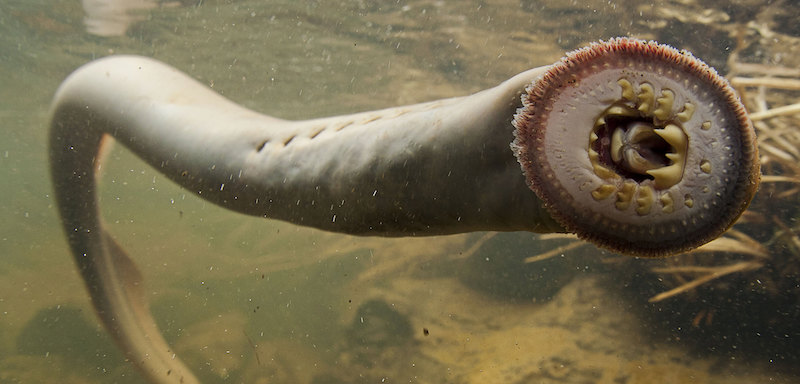
After their larval stage, they grow eyes and their circular-saw mouth, and start a long journey to the ocean. Little is known about their life at sea, but we do know that they attach themselves to a big host fish or whale for two years or more, just hanging on and sucking blood. After a buffet of liquid fish (and a big growth spurt), fattened adult lamprey start the journey back inland to spawn.
The way home is not easy! For one, adult lamprey don’t eat at all on the trip home, living solely off of fat reserves. For another, it’s very difficult for a mostly finless fish to get over falls and dams. They use their circular-saw mouths to latch on to and inch their way over boulders and waterfalls. Once they reach their spawning habitat, they mate and die, starting the cycle over again.
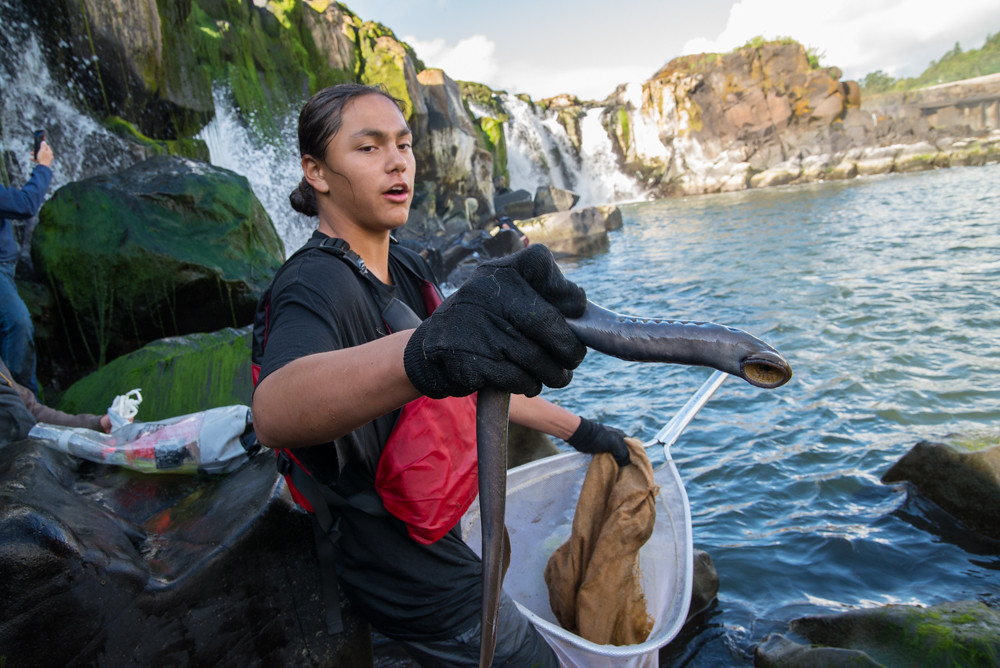
Like other anadromous fish, their survival depends on managing the four H’s: habitat, harvest, hatcheries, and hydropower. In particular, hydropower has led to enormous population declines. Lamprey are weak swimmers, and do not swim up fish ladders as easily as salmon and steelhead. Reservoirs also degrade lamprey spawning habitat and expose them to increased predation.
This collapse has harmed local Indigenous people. Lamprey are a key ceremonial food source of the Nez Perce and other Columbia Plateau Tribes, often caught by hand during migration. Their fatty meat is very nutritious and is often smoked and fed to children. Nez Perce Tribal elder Horace Axtell recalled:
“My great aunt was a medicine woman, and she would collect the fat that would drip off an eel as it was cooking over a fire. She would store the fat in a small bottle and use it for oil in lamps and for medicines.” (source: critfc.org)
White settlers largely overlooked the lamprey, or used them for bait. At the Celilo hatchery, (at the now-flooded Celilo falls), tens of thousands were caught and ground into fish food for salmon, basically propping up one rare species with another. It didn’t last long though. After the damming of northwestern rivers in the 1960s, populations collapsed.
In 2003, the Center for Biological Diversity and other northwest environmental groups petitioned the US Fish and Wildlife Service to list the fish on the Endangered Species Act. Unfortunately, the USFWS sidestepped listing lamprey as a threatened species, citing a lack of data.
Instead, they created a collaborative organization, the Pacific Lamprey Conservation Initiative, that has so far failed to alter the long-term declines of lamprey in the West. Such collaborative efforts are politically expedient but often legally unenforceable, undercutting the agency’s broad powers to protect our native wildlife.
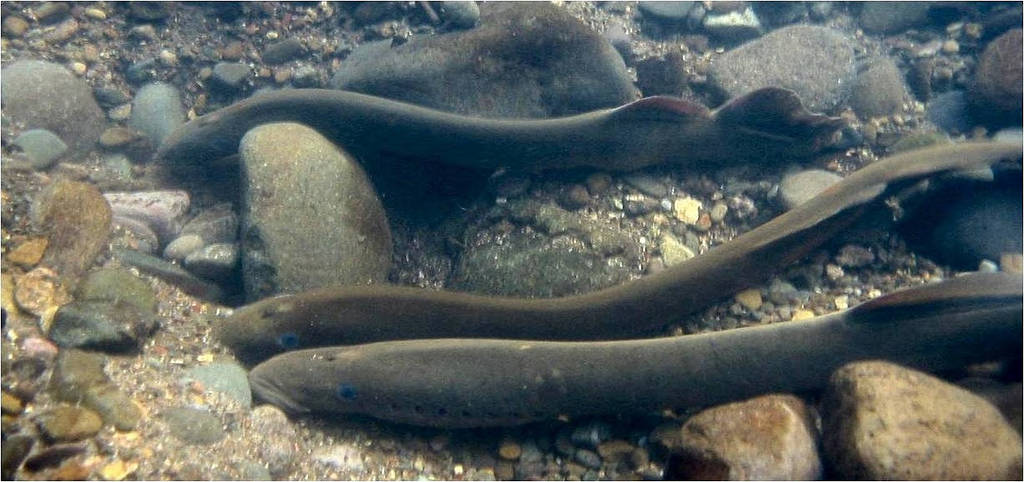
In the Clearwater, populations of lamprey are functionally extinct. The 10-year average returning lamprey at the Lower Granite Dam is only 102 per year, down from perhaps tens of thousands prior to hydropower. Almost all individual Clearwater and Snake River basin populations are listed as critically imperiled or possibly extinct, as per a 2019 USFWS assessment.
The exceptions are in areas adult fish have been reintroduced by the Nez Perce Fisheries, like Asotin Creek, the Grande Ronde River, and the South Fork of the Salmon River. The Nez Perce and other Northwest Tribes have been very active in advocating for and reintroducing lamprey.
The fate of the lamprey, much like for salmon and steelhead, depends on breaching the Lower Four Snake River dams. As of 2024, political efforts to breach the dams have stalled, though staunch opposition to breaching is waning as fish populations collapse.
Friends of the Clearwater advocates for a future without the Lower Snake Dams, and with Pacific lamprey, perhaps the strangest critter in Idaho.
Friends of the Clearwater
PO Box 9241
Moscow, ID 83843
(208) 882-9755