The Place
The Selway-Bitterroot Wilderness (SBW, or just Selway) is one of the great achievements of conservation in the United States. At more than 1.3 million acres, this wilderness area protects most of the Selway River basin in Idaho and the high Bitterroot mountains in Montana.
The Selway is one of the original wildernesses designated by Congress under the 1964 Wilderness Act and was expanded in the 1980 Central Idaho Wilderness Act. Only the Southern Nez Perce Trail (the Magruder Corridor), an unimproved dirt road, separates the Selway-Bitterroot from the even larger Frank Church-River of No Return Wilderness to the South. Together, they would constitute the largest protected wild place in America outside Alaska.

The size of this wild area is matched only by its stunning diversity. The northwestern border of the wilderness abuts the Lochsa River, just 1800 feet (550 m) above sea level. This part of the Wilderness is wet and lush, supporting coastal disjunct species like Western red cedar and some of the only inland populations of Pacific dogwood. Visitors can camp at the Wilderness Gateway Campground on US Highway 12 to experience the Lochsa River and Selway-Bitterroot Wilderness.
At the southwestern edge of the wilderness careens Selway Falls. Here, at the right time of year, visitors can see migrating steelhead and chinook salmon leap above the whitewater as they make their way to their natal streams. The entire Selway River is protected under the Wild and Scenic Rivers Act; fish can swim its roughly 100 river miles without encountering a dam.
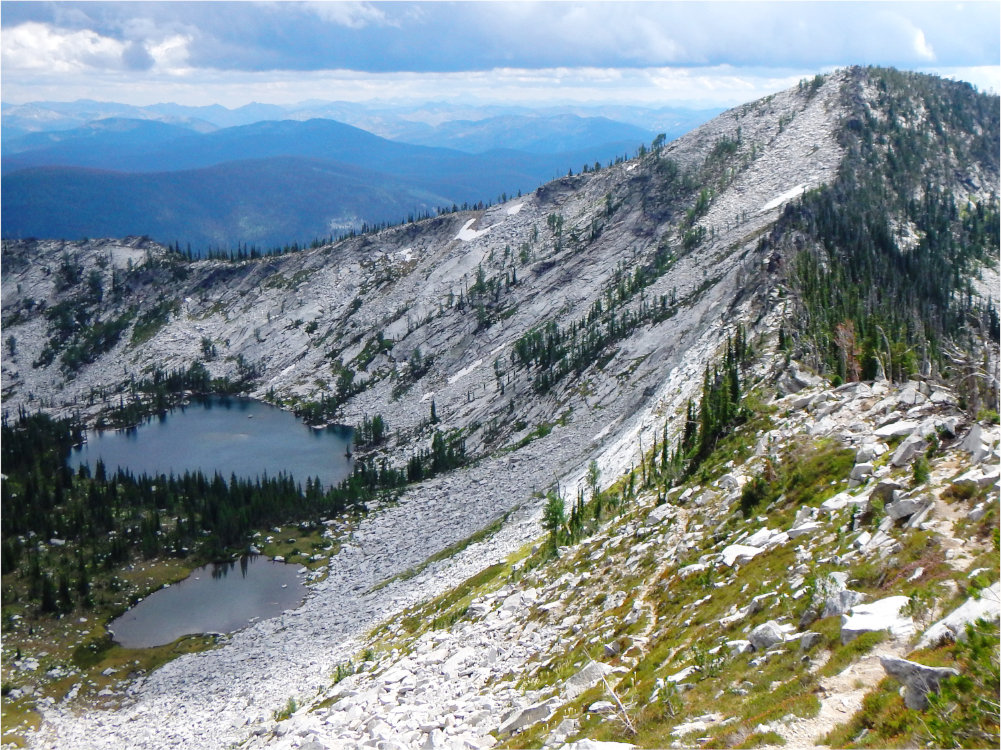
The further upriver you travel, the higher you climb. The headwaters of the Selway lie in the High Bitterroots: 9,000-foot (2600 m) granite peaks on the Idaho-Montana state line. Just to the east of this ridge in Montana is Trapper Peak (10,157 ft/3096 m), the highest point in the Bitterroots. These granite towers are steep, cold, and windy, too extreme for most trees. Wind-bent whitebark pine live here, providing nuts for Clark’s nutcrackers.
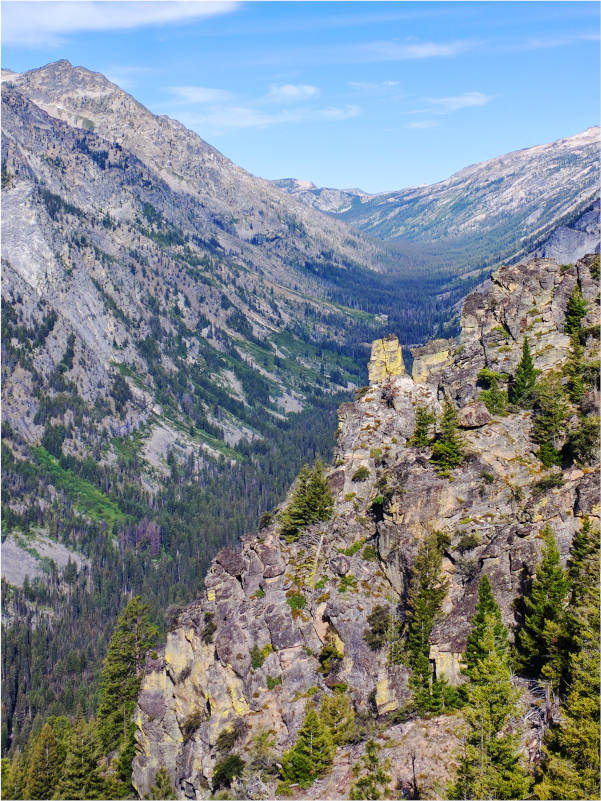
During the Last Glacial Maximum, valley glaciers gouged out this whole area, leaving enormous U-shaped valleys not unlike those in Glacier National Park. These mountains are best seen and accessed from Highway 93 in Montana, where they form a massive palisade running north-south for nearly 50 miles, starting near Lolo and ending near Connor.
In between the hot, wet Selway canyon and the snow-bound, craggy Bitterroot crest is enough wild country to get lost in for a lifetime – and abundant great habitat for wildlife.
Wildlife
Diverse habitats support diverse wildlife. The lower Selway provides winter range for many ungulates and year-round habitat for moose, wolves, black bears, fishers, wolves, and possibly grizzly bears. Steelhead and salmon still make their way up the Wild and Scenic Selway River as they have done for millennia. In summer, harlequin ducks fly inland from the coast to nest along the fast-running streams. The avid birder may also see osprey, bald eagles, mergansers, spotted sandpipers, dippers, and kingfishers in the river canyon.

The high peaks of the SBW offer refuge for wolverines, snowshoe hares, mountain goats, and lynx. Recent studies indicate that the Bitterroot crest would make for top-tier denning habitat for grizzly bears, which are moving into the area. The cold mountain streams of the Bitterroots are ideal for Westslope cutthroat and Bull trout.
History
The Selway is an important place to the Nimiipuu, who have used the area for centuries. Trails 206 and 664, for example, closely follow one ancient trail that the Nimiipuu navigated on their travels between Clearwater Country and the Great Plains of present-day Montana along the Selway Crags.
The southern Nez Perce Trail, also used for reaching Montana, became the basis of today’s Magruder corridor, the southern border of the Wilderness. South of that dirt road is the Frank Church-River of No Return Wilderness.

Management and Threats
The Selway features many hiking trails as well as some remote spots without maintained paths. During the main floating season, the Forest Service allows just one party per day to launch non-motorized boats on the Selway River — a very popular trip.
Fires are mostly allowed to play their natural role, especially in the Idaho portion of the wilderness. Indeed, the Selway-Bitterroot was the first place where managers intentionally allowed a lightning strike to burn into a fire and go out on its own in the early 1970s.
However, the wilderness character of this area is harmed by overbuilt trails and Forest Service structures and sites, including landing strips in meadows, such as at Fish Lake. The Idaho Fish & Game Department also exerts political pressure on the Forest Service to promote highly manipulative game management rather than a wilderness-protection management mentality.
Unprotected Wildlands
Several roadless areas directly adjacent to the Selway-Bitterroot could be added to the designated wilderness. Together they add up to about 580,000 acres of unprotected wilderness. These include the following in Idaho:
- Meadow Creek (200,000 acres)
- Sneakfoot Meadows (23,000 acres)
- South Lochsa Slope (75,000 acres)
- Rackliff-Gedney (90,000 acres)
Two potential additions are primarily in Montana:
- Lolo Peak (18,000 acres)
- Bitterroot Face (123,000 acres)
The Bitterroot Face is currently at risk of development. Nearly all of that roadless area is targeted for logging and road-building under the Bitterroot Front Project on the Bitterroot National Forest.